

Table of Contents
- Why parents are moving away from artificial gummy vitamins
- What's actually in artificial gummy vitamins, and why it matters
- Best natural multivitamin sources for picky eaters
- How to boost child focus naturally without artificial supplements
- Whole food alternatives that actually work
- Reading supplement labels: what to look for and what to avoid
- Making the switch: practical steps for your family
Last Updated: August 26, 2026
Why parents are moving away from artificial gummy vitamins
You know the feeling. You've spent £15 on a bottle of gummy vitamins, convinced this time your child will actually take them. Then they spit them out, leave them in a sticky pile on the kitchen table, or refuse them entirely because they taste "weird."
The truth is, many parents are stepping back from artificial gummy vitamins altogether. Most commercial gummy vitamins contain artificial dyes, synthetic sweeteners, and ingredients that sound more like a chemistry experiment than nutrition. Even worse, the sugar content undermines the whole purpose of supplementing your child's diet.
This is where natural alternatives to artificial gummy vitamins come in. Parents are discovering that whole foods, plant-based supplements, and carefully formulated powders like LittleVitz's Kids Super Greens offer a genuinely better path forward. They taste better, work better, and don't come with the guilt of feeding your child artificial additives disguised as health.

What's actually in artificial gummy vitamins, and why it matters
If you flip over a bottle of standard gummy vitamins, the ingredient list reads like a food colouring factory. Artificial dyes like FD&C Red No. 40, Yellow No. 5, and Blue No. 1 make the gummies look appealing (concerns about their impact on children's behaviour have been raised by various [EXTERNAL_LINK: food safety bodies | food.gov.uk], leading to stricter regulations in some regions). Synthetic sweeteners such as maltitol and sorbitol replace sugar but come with their own problems, digestive distress being the most common complaint parents report.
Most artificial gummies rely on gelatin combined with corn syrup, glucose, and modified starch. The texture might be appealing, but the nutritional density is low. You're essentially paying for coloured sugar with a handful of vitamins sprinkled in.
The bioavailability, how well your child's body actually absorbs and uses these nutrients, is compromised by the sugar content and artificial additives. Your child's digestive system has to work harder to extract the actual vitamins from all the synthetic ingredients.
Artificial gummies often contain preservatives and additives that can trigger sensory sensitivities, digestive issues, or allergic reactions in children with ARFID (Avoidant/Restrictive Food Intake Disorder) or other food-related challenges. For parents managing these conditions, artificial gummy vitamins often become another "unsafe" food their child refuses.
The NHS guidance on children's nutrition emphasises that whole foods should be the foundation of a child's diet, with supplements filling specific gaps, not replacing real nutrition.
Best natural multivitamin sources for picky eaters
Here's what actually works for picky eaters: stop thinking about vitamins as a separate thing your child has to consume, and start thinking about nutrition as something you can hide in foods they already love.
The best natural multivitamin sources aren't pills or gummies, they're whole foods and carefully formulated powders designed to taste good enough that your child won't fight you. For a child who "only eats chicken nuggets and pasta," adding a chocolate-flavoured nutrition powder to milk transforms it from a battle into a treat.
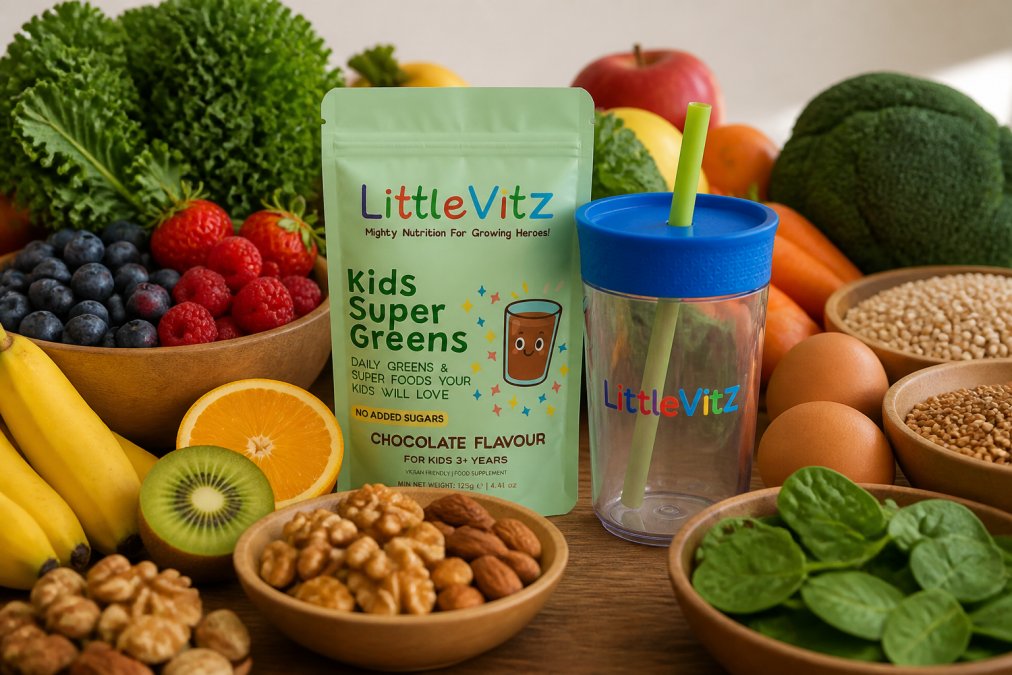
LittleVitz's Kids Super Greens is specifically designed for this challenge. It's a chocolate-flavoured powder packed with over 30 vitamins, minerals, and superfoods including real greens, fruits, and essential nutrients. The chocolate flavour masks the vegetable taste completely, which means a child who refuses broccoli will happily consume the nutritional equivalent mixed into milk or a smoothie. It's comparable to buying multiple bottles of artificial gummies, but the nutrient density is incomparably higher.
For children with texture sensitivities, powders have a clear advantage over gummies. A powder dissolves completely, leaving no "weird texture" in the mouth. You can mix it into warm milk, blend it into fruit smoothies, or stir it into yoghurt without your child detecting it.

Other natural multivitamin sources that work well for picky eaters include:
- Fortified nut butters, Almond or peanut butter with added vitamins, spread on toast or mixed into smoothies
- Bone broth, High in minerals and amino acids; can be used as a base for soups or sipped warm
- Egg yolks, Packed with choline, lutein, and fat-soluble vitamins; scrambled eggs are hard to refuse
- Fortified plant-based milks, Many now include added vitamins D, B12, and calcium
- Dried fruit and nut blends, Naturally sweet, packed with minerals and fibre
The key is consistency. A child who takes one spoonful of LittleVitz powder daily will see better results than a child who takes gummy vitamins three times a week and refuses them the other days.
How to boost child focus naturally without artificial supplements
Focus in children is built on three foundations: stable blood sugar, adequate omega-3 intake, and consistent sleep. Artificial gummy vitamins don't address any of these.
Stable blood sugar is the biggest factor. Children who consume artificial gummies often experience a sugar spike followed by a crash, which actually worsens focus and attention. A chocolate powder like LittleVitz, formulated with no added sugar, provides sustained energy without the crash.
Omega-3 fatty acids are critical for brain development and focus. Rather than relying on gummy supplements, focus on whole foods: fatty fish like salmon, walnuts, chia seeds, and flaxseeds. These provide bioavailable forms of DHA and EPA that your child's brain can actually use.
Sleep quality directly impacts focus. A child consuming artificial additives and excess sugar often experiences disrupted sleep, which cascades into poor attention the next day. Removing artificial dyes and synthetic sweeteners frequently improves sleep quality within one to two weeks.
For children struggling with focus, the most effective approach is:
- Remove artificial additives, Cut out artificial dyes, synthetic sweeteners, and processed foods for two weeks and observe changes
- Add whole food nutrition, Introduce foods rich in B vitamins, magnesium, and omega-3s
- Use a clean supplement, If gaps remain, add a natural powder like LittleVitz that provides concentrated nutrition without artificial ingredients
- Maintain consistent sleep and movement, Focus supplements can't overcome poor sleep or lack of physical activity
This approach produces measurable results within weeks.
Whole food alternatives that actually work
Whole foods are always superior to supplements, but only if your child will eat them. The practical question becomes: what whole foods can you realistically get your child to consume, and what gaps remain?
Start by identifying your child's "safe foods", the foods they'll reliably eat without resistance. Build nutrition around those. If your child eats chicken, pasta, and bananas, you're already getting protein, some B vitamins, and potassium. The gaps are likely in iron, calcium, and micronutrients from vegetables.
Here's a practical whole food strategy for different nutritional gaps:
Nutritional Gap |
Whole Food Source |
How to Serve |
|---|---|---|
Iron |
Beef, lentils, fortified cereals |
Mix lentils into pasta sauce; serve with vitamin C |
Calcium |
Yoghurt, cheese, fortified milk |
Serve as snacks; mix into smoothies |
Vitamin D |
Fatty fish, egg yolks, mushrooms |
Baked salmon with pasta; scrambled eggs |
Magnesium |
Pumpkin seeds, almonds, spinach |
Toast seeds as snacks; hide spinach in smoothies |
Zinc |
Meat, shellfish, pumpkin seeds |
Ground meat in familiar dishes; seeds in granola |
Vitamin C |
Berries, citrus, peppers |
Fresh berries as snacks; orange juice with meals |
Most picky eaters won't consume enough whole foods to meet all their nutritional needs. This is where a supplement like LittleVitz bridges the gap. It provides the micronutrients that whole foods alone can't deliver, without artificial ingredients that trigger sensory or digestive issues.
A practical approach: use whole foods as your foundation, and use a clean supplement to fill specific gaps.
Reading supplement labels: what to look for and what to avoid
Most parents don't read supplement labels carefully, they just check if the bottle says "natural" and call it a day. The word "natural" on a label means almost nothing. What matters is what's actually listed in the ingredients.
Here's what to look for on a supplement label:
Good signs:
- Ingredient list is short and recognisable (you can pronounce everything)
- No artificial dyes (FD&C colours, tartrazine, etc.)
- No synthetic sweeteners (aspartame, sucralose, acesulfame K)
- Specific nutrient amounts listed (not just "proprietary blends")
- Real food sources listed (e.g., "fruit extract" rather than vague "natural flavours")
Red flags:
- Long ingredient list with unrecognisable chemicals
- "Proprietary blend" listed instead of specific amounts
- Artificial colours or dyes of any kind
- Sugar listed as a primary ingredient
- Vague terms like "natural flavours" or "natural colours"
- No third-party testing information available
LittleVitz's Kids Super Greens is transparent about its ingredients: real greens, real fruits, real vitamins and minerals, no artificial additives, no added sugar. The label tells you exactly what you're getting.

When comparing supplements, don't just look at price. A bottle with artificial ingredients is more expensive than a powder with real nutrition, because your child actually benefits from the expensive one.
The Which? guide to reading children's supplement labels provides a detailed breakdown of what to look for and common misleading claims on children's products.
Making the switch: practical steps for your family
If you're moving away from artificial gummy vitamins, the transition doesn't have to be complicated. Here's how to do it without triggering a power struggle with your child.
Step 1: Introduce the new supplement gradually
Don't throw out the old gummies and announce a complete change. Instead, introduce the new supplement (like LittleVitz) alongside familiar foods your child already loves. Mix a small amount into their usual milk, smoothie, or yoghurt. Let them get used to the taste without pressure.
Step 2: Make it part of a routine, not a battle
The best time to introduce a new supplement is when it fits naturally into your child's day. If they have hot chocolate in the morning, that's your window. If they drink a smoothie after school, that's another opportunity. Attach the supplement to an existing habit rather than creating a new "supplement time."
Step 3: Be honest about why you're changing
Depending on your child's age, you can explain: "We're trying something new that tastes better and is better for your body." You don't need to make it dramatic, just frame it as an upgrade.
Step 4: Give it time
Most children adapt to new tastes within two to three weeks. Consistency matters far more than perfection.
Step 5: Track what changes
After four weeks on a clean supplement, notice: Is your child sleeping better? More focused at school? Fewer digestive complaints? These improvements often appear before you expect them, and they reinforce the decision to switch.
Making the switch from artificial gummy vitamins to natural alternatives is one of the simplest changes you can make to support your child's health, and it often leads to measurable improvements in sleep, focus, and digestion within weeks. LittleVitz Kids Super Greens removes the guesswork by combining real nutrition with a chocolate flavour your child will actually enjoy. Buy Super Greens and experience the difference whole-food nutrition makes for picky eaters.
Frequently Asked Questions
Why do dentists and nutritionists often advise against gummy vitamins?
Gummy vitamins contain high sugar content and stick to teeth, increasing the risk of dental erosion and decay. The prolonged contact with tooth surfaces makes them more damaging than tablet or powder forms. Additionally, artificial dyes and sweeteners in conventional gummies offer no nutritional advantage and may cause digestive distress in sensitive children. Natural alternatives eliminate these concerns while providing better nutrient absorption.
What ingredients should I avoid in children's gummy supplements?
Avoid artificial dyes (like tartrazine and allura red), synthetic additives, and high-fructose corn syrup. Sugar alcohols such as sorbitol can trigger digestive issues in picky eaters. Check labels for gelatin sourcing and unnecessary preservatives. Look instead for plant-based pectin, natural fruit extracts, and third-party certification marks. These indicate cleaner formulations that support your child's health without hidden nasties.
How can I ensure my picky eater gets enough nutrients without artificial additives?
Combine whole food sources—leafy greens, berries, nuts, and eggs—with a natural supplement like a chocolate-flavoured nutrition powder designed for fussy eaters. Powders mix easily into milk or smoothies, making them invisible to children with texture sensitivities. Pair this with consistent exposure to nutrient-dense foods and consider third-party tested supplements to confirm you're meeting daily micronutrient needs. This approach bridges nutritional gaps without relying on artificial gummies.
Are powdered whole-food supplements more effective than gummies?
Yes, powdered supplements generally offer better bioavailability because they dissolve and absorb more efficiently in the digestive system. Gummies must be chewed and broken down, which can degrade certain nutrients before absorption. Powders made with real superfoods, fruits, and vegetables retain more nutritional value and avoid the sugar and artificial ingredient load of conventional gummies. For children with digestive issues or limited 'safe food' diets, powders provide superior nutrient delivery.