

Table of Contents
- Why Parents Buy Natural Nutrient Powder for Kids
- What to Look For When You Buy Natural Nutrient Powder for Kids
- The Best Kids Supplement for Picky Eaters: What Actually Works
- Sugar-Free Nutritional Supplements for Kids: Why It Matters
- How to Get Nutrients Into Picky Eaters: Taste, Texture and Daily Habits
- Common Mistakes to Avoid
- Frequently Asked Questions
Last Updated: September 23, 2026
Why Parents Buy Natural Nutrient Powder for Kids
When a child lives on beige food, every mealtime can feel like a negotiation. That's why so many parents now look for a natural nutrient powder for kids: a simple way to top up the vitamins, minerals and greens that a limited diet leaves out. This guide from LittleVitz walks you through what to check, what to avoid and how to tell whether a powder will actually work for your child.
What to Look For When You Buy Natural Nutrient Powder for Kids
Start with the label, not the marketing. A good children's supplement is filler-free, sugar-free and transparent about every ingredient it contains. If a brand hides behind a "proprietary blend" with no amounts listed, put it back on the shelf.
Here's a quick checklist for reading any tub:
- Full ingredient list with amounts per serving
- No added sugar or artificial sweeteners
- No artificial colours or preservatives
- Allergen information clearly stated, including "may contain" warnings
- Independent testing mentioned (look for UKAS-accredited labs or a named testing standard)
- Age guidance printed on the pack
- Batch number and best-before date visible
Ingredients to Avoid in Children's Supplements
Artificial sweeteners such as aspartame and sucralose are common in kids' vitamins, and many parents prefer to skip them entirely. Watch for bulking agents (maltodextrin, cellulose), cheap gums (xanthan, guar) and added flavourings too. A short, recognisable ingredient list is usually a better sign than a long one.
Two specific things worth flagging on any label:
- Vitamin A in the retinol form, the NHS advises against giving children aged 1-4 more than 800 micrograms of retinol equivalent per day, because it accumulates in the body. Beta-carotene (a plant form) is safer in a daily powder.
- High-dose zinc or iron without a stated reason, these can cause stomach upset in young children and should only be given at therapeutic doses under medical advice.
Allergen and Sensitivity Checks: A Parent's Guide
This is the section most buying guides skip, and it's the one that matters most if your child has a diagnosed allergy or intolerance. "Natural" does not mean "allergen-free", nuts, seeds, dairy and soy all appear in green powders.
| Allergen | Common in kids' powders as | What to look for |
|---|---|---|
| Milk | Whey or casein protein base | "Dairy-free" claim plus a dairy-free facility statement |
| Soya | Soy lecithin (emulsifier) | Lecithin from sunflower instead |
| Nuts | Almond flour, hazelnut flavour | "Nut-free facility" wording, not just "no nuts added" |
| Peanuts | Rare, but check "may contain" | Explicit peanut-free statement |
| Gluten | Barley grass, wheatgrass, oat base | "Gluten-free" certified to 20ppm or less |
| Egg | Rare in powders, common in gummies | Vegan claim usually covers this |
| Sesame | Increasingly used in seed blends | Named on the allergen panel |
| Fish/shellfish | Omega-3 from fish oil | Algae-oil omega-3 is the vegan alternative |
- "May contain" is not a legal cop-out, it's a real risk statement. If your child has a severe allergy, treat it as a no.
- "Made in a facility that also handles..." is different from "made on shared equipment". The first is a broader risk; the second is more contained. Ask the brand directly if the wording is vague.
- Coeliac disease is not the same as gluten sensitivity. For coeliac children, only a certified gluten-free product (tested to below 20 parts per million) is safe.
- Lactose intolerance is not a milk allergy. A lactose-free product may still contain milk protein, which is the actual allergen.
The Best Kids Supplement for Picky Eaters: What Actually Works
LittleVitz Kids Super Greens is built around this exact problem. It's a chocolate-flavoured powder made with real greens, fruits and vitamins, and it carries no added sugar. You can try a 5-serving trial pouch before committing to a full tub, which is a sensible way to test the taste barrier first.

Sugar-Free Nutritional Supplements for Kids: Why It Matters
Sugar-free nutritional supplements for kids matter because most children already take in far more sugar than they need. Gummies are the biggest culprit: many are closer to sweets than supplements. If a "healthy" vitamin is coated in glucose syrup, you're solving one problem and creating another.
What to look for instead:
- Sweetened naturally, or not at all
- No glucose syrup, dextrose or maltodextrin high on the list
- No sugar alcohols if your child has a sensitive tummy
How to Get Nutrients Into Picky Eaters: Taste, Texture and Daily Habits
Getting nutrients into a picky eater works best when you stop treating it as a battle and start treating it as a habit. Small, repeatable steps beat one-off heroic efforts every time.
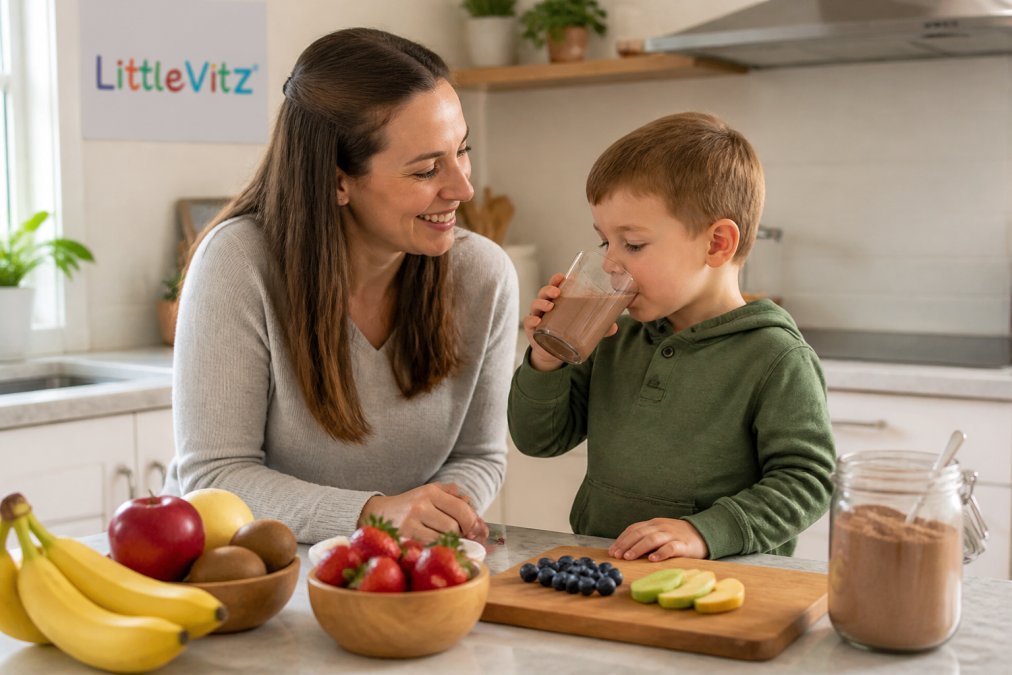
A few habits that make a real difference:
- Serve the powder at the same time each day, so it becomes routine
- Let your child help scoop and stir, which builds ownership
- Pair it with a food they already trust, like milk or yoghurt
- Keep offering the vegetables alongside, without pressure
- Keep the portion small, half a scoop is a full win on day one
Taste-Testing With Your Child: A Method, Not a Guess
The single biggest reason a tub ends up half-used is texture. Natural greens and fruit powders are gritty by nature, and most children notice grit before they notice flavour. Here's a method that works:
- Start with a base your child already drinks. Cold milk, a fruit smoothie or a flavoured yoghurt drink. Cold dulls bitterness, which helps with stronger-tasting greens.
- Use half a scoop for the first three days. This is enough to test acceptance without overwhelming the taste.
- Whisk, don't stir. A fork leaves clumps; a small whisk or a shaker bottle breaks them down. If your child will drink through a straw, that also helps bypass grit on the tongue.
- Watch the face, not the words. A grimace on sip one is normal. A refusal to take sip two is the real signal.
- Change one variable at a time. If it's refused, try a different base, then a different temperature, then a different time of day. Don't change all three at once or you won't know what worked.
- Give it five tries across five days. Repeated exposure is well documented in feeding research, most children need multiple introductions before a new taste is accepted.
Cost-Per-Serving: What You're Actually Paying For
Cost-per-serving is the number that matters, not the price on the tub. Divide the pack price by the number of servings to compare fairly, and remember that a refused powder costs more per accepted serving than a pricier one your child actually drinks.
| Option | Typical servings | Cost per serving | Best for |
|---|---|---|---|
| Trial & travel pouch | 5 | Highest per serving | First-time taste test |
| Full tub | 25 | Lowest per serving | Established daily routine |
| Gummy multivitamin | 30 | Low, but often refused | Children who chew happily |
| Flavoured milk drink | 1 | Highest per serving | On-the-go topping up |
A few budgeting rules of thumb:
- Buy the trial size first, always. The saving on a full tub is meaningless if the tub goes in the bin.
- Compare like with like. A 25-serving tub and a 60-serving tub aren't comparable until you've divided by servings.
- Factor in the base liquid. If the powder only tastes acceptable in a specific smoothie, that smoothie is part of the cost.
- Watch for subscription pricing. Many brands discount heavily on subscription, but only commit once you know your child will drink it.
- Don't double up. If your child already takes a multivitamin, adding a greens powder on top is money spent on nutrients they may not need.
Common Mistakes to Avoid
The biggest mistake is buying on price alone. A cheap powder your child refuses is more expensive than a good one they drink. The second is expecting a supplement to fix a limited diet overnight. It won't. It bridges gaps while you keep working on variety.
Other common slips:
- Ignoring the allergen panel because the front of the pack looks clean
- Starting with a full scoop instead of a half
- Giving up after one refusal, when it often takes several tries
- Skipping the label and trusting the front-of-pack claims
Frequently Asked Questions
What should I look for when buying natural nutrient powder for kids?
Check the ingredient list first. Look for real food sources like greens, fruits and vegetables rather than long lists of synthetic fillers. Avoid added sugar, artificial sweeteners and unnecessary gums. Look for independent testing or clear allergen labelling. A good natural nutrient powder should list vitamins and minerals with amounts per serving, not just a vague 'proprietary blend'. If your child has allergies or a medical condition, speak to your GP or a registered dietitian before starting any supplement.
Are sugar-free nutritional supplements for kids actually safe?
Sugar-free supplements can be a sensible choice, especially if your child already gets sugar from other foods. The key is what replaces the sugar. Some products use artificial sweeteners like aspartame or sucralose, which some parents prefer to avoid. Others use natural options or no sweetener at all. Always read the label and choose a product with clear ingredient sourcing. If your child has diabetes or another condition affecting blood sugar, check with their healthcare team first.
How do I get nutrients into a picky eater who refuses anything green?
Start by mixing a nutrient powder into something they already love, like milk, a smoothie or a yoghurt. Chocolate-flavoured options tend to go down better than plain green powders. Introduce it gradually, maybe half a scoop at first, and let your child help stir it in. Keep offering small tastes of real vegetables alongside the powder without pressure. The powder bridges the gap while you keep working on variety. Consistency matters more than perfection.
Is a kids supplement for picky eaters worth the cost compared to regular multivitamins?
It depends on what you need. A basic multivitamin covers vitamins and minerals but often misses the broader range of plant-based nutrients found in greens and fruit powders. A nutrient powder with superfoods typically costs more per serving but can replace several separate products. Work out the cost per serving rather than the pack price. If your child eats almost no vegetables, a powder with real food ingredients may offer better value than a cheap tablet they refuse to swallow.
Fussy eating is a phase, but the nutritional gaps it leaves behind are real. LittleVitz makes a chocolate-flavoured Kids Super Greens powder with no added sugar, real greens, fruits and vitamins, and a 20+ superfood blend that supports healthy growth, focus and immunity. Start with the trial pouch to test the taste, then move to the full tub once it's part of the routine. Get started with LittleVitz and turn the daily veggie battle into something your child actually asks for.