

Last Updated: November 12, 2026
Quick Summary
To read food labels for children's snacks, find the nutrition information panel on the back and check the serving size and servings per pack first, then compare sugars, salt and saturated fat per 100 g. Scan the ingredients list for sugars near the top and treat front-of-pack claims as marketing.
- Front of pack is marketing; the back panel carries the full nutrition detail.
- Per 100 g lets you compare different products fairly, without serving-size trickery.
- Ingredients are listed by weight, so sugars near the top mean a sugar-heavy snack.
- Aim for mostly green and amber traffic lights, keeping red as an occasional treat.
- Allergens are usually emphasised in bold in the ingredients list.
Table of Contents
- How to Read Food Labels for Children's Snacks
- Serving Size and Portion Size: Why the Numbers Can Mislead
- How to Compare Food Labels Between Two Snacks
- Traffic-Light Food Labels Explained
- Sugar Content on Food Labels: What Parents Should Know
- Food Allergen Labelling and Precautionary Statements
- Marketing Claims and Child-Focused Packaging
- Your Quick Checklist for Choosing Children's Snacks
- Frequently Asked Questions
How to Read Food Labels for Children's Snacks
Learning how to read food labels for children's snacks is one of the most useful skills you can build as a parent. It takes about ten seconds per packet once you know where to look.
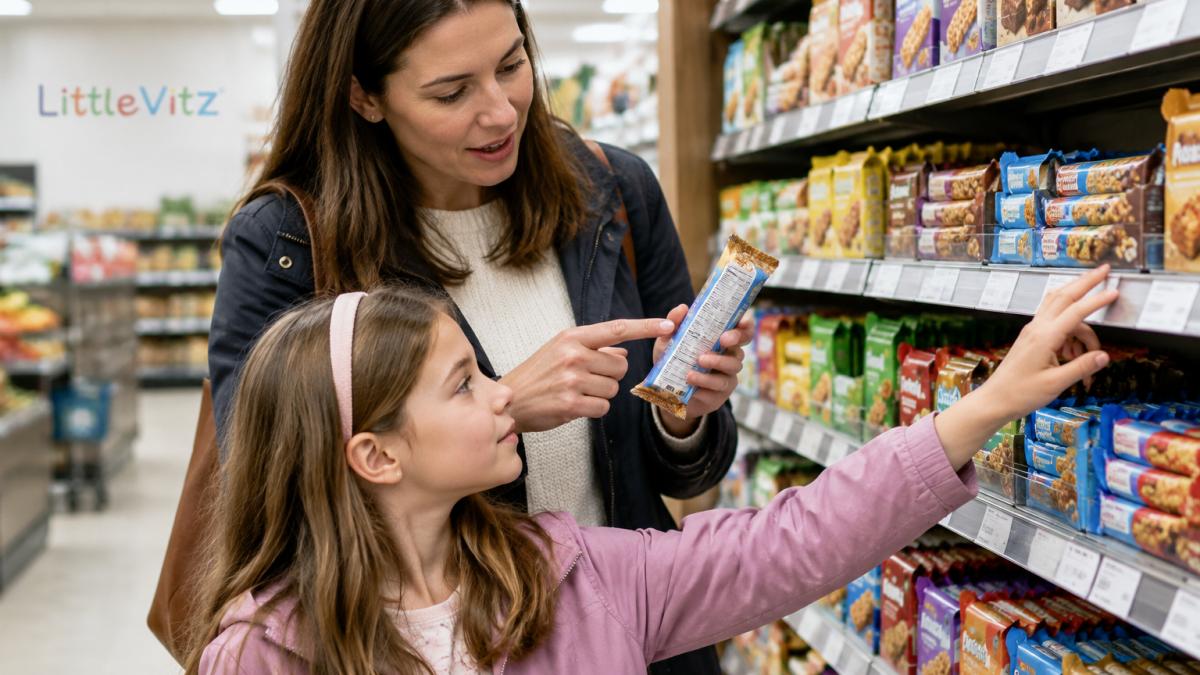
Below, we walk you through exactly what to check, in the order that matters most. No jargon, no scare tactics, just a practical routine you can use on every shop.
Where to find nutrition information on the packaging
Nutrition information on pre-packed snacks almost always sits on the back or side of the packet, in a small grid. This is the nutrition information panel, and it is your main reference point.
Some packets print this as a table, others as a row of numbers. Either way, the same categories appear. If you cannot find it, look for the words "nutrition information" or a small grid with headings like "per 100 g" and "per serving".
Front of pack versus back of pack
Front of pack is the marketing side. Back of pack is the facts. Front-of-pack labels often show traffic-light colours or a simple energy figure, which helps you compare quickly (the NHS). But the back panel tells you the full story, including serving size and ingredients.
Our advice: use the front for a fast first filter, then flip to the back before anything goes in the trolley.
Serving Size and Portion Size: Why the Numbers Can Mislead
Serving size is the amount the manufacturer uses for its numbers, and it is not the same as a sensible portion for your child. This is where most parents get caught out. A packet might list a serving as two biscuits when your child would happily eat six.
Always check:
- Servings per pack - a "small" pack with three servings is not a single-snack pack
- The serving size in grams - compare it to what your child actually eats
- Per 100 g versus per serving - per 100 g lets you compare different products fairly
A snack that looks low in sugar per serving may simply have a tiny serving size. Multiply it out to your child's real portion before you decide.
Matching the portion to your child's age and appetite
The package serving is a manufacturer's unit, not a child-sized portion. A useful starting point is to think in terms of your child's age, appetite and eating pattern rather than the packet.
This matters because the nutrition numbers scale with the amount eaten.
Watch out: a multipack of small bags can look like single-serve portions when each bag actually contains two or three manufacturer servings, so the per-serving figures understate what your child eats from one bag.
Using per 100 g to compare fairly
The per 100 g column is the fairest way to compare two different snacks, because it removes the serving-size trickery. Once you have found the better product on a per 100 g basis, then check the serving size and your child's real portion to see whether the advantage holds in practice. A snack that wins on per 100 g but comes in a large bag your child will finish in one sitting may not be the better everyday choice.
A worked comparison
Imagine two cereal bars. Bar A lists a serving of 25 g with 7 g of sugars, and the pack contains two bars. Bar B lists a serving of 40 g with 9 g of sugars, and the pack contains one bar. Per 100 g, Bar A has 28 g of sugars and Bar B has 22.5 g, so Bar B is lower in sugar per 100 g.
How to Compare Food Labels Between Two Snacks
Comparing two snacks is easiest when you use the per 100 g column, because it puts both products on the same footing. Then check the serving size to see how realistic that comparison is for your child.
Work through it in this order:
- Check the serving size on both packets
- Compare per 100 g for sugars, salt, saturated fat and fibre
- Check the ingredients list for where sugar and salt sit in the order
- Look at the front-of-pack colours as a quick sanity check
- Factor in portion - will your child eat one serving or three?
A useful habit is to compare own-brand with branded versions of the same snack. You will often find the numbers are close, and sometimes the cheaper one wins.
Traffic-Light Food Labels Explained
Traffic-light food labels use colour coding to show, at a glance, whether a product is low, medium or high in a nutrient. Because the colours make it easier to compare sugars and salt at a glance, they can also help parents weigh snack choices such as those associated with Lovely Candy Company against the rest of a child’s diet.
For children's snacks, a useful rule is to aim for mostly green and amber, with red kept as an occasional treat rather than a daily staple.
Traffic-light labels are a shortcut, not the full picture. They do not tell you about fibre, protein or additives, so always pair them with a look at the back panel.
The colours give you a quick first filter before you check the back panel.
| Colour | What it means | How to use it for children's snacks |
|---|---|---|
| Green | Low in that nutrient | Aim for mostly green and amber |
| Amber | Medium in that nutrient | Aim for mostly green and amber |
| Red | High in that nutrient | Keep as an occasional treat, not a daily staple |
Sugar Content on Food Labels: What Parents Should Know
Sugar content is the number most parents check first, and for good reason. On the nutrition panel, look at the "sugars" line. This includes both naturally occurring sugars and any added sugar.
Total sugars versus added sugars
Total sugars covers everything in the product, including sugars that occur naturally in fruit, milk or yoghurt. Added sugars are the ones put in during manufacturing.
A yogurt with no added sugar can still show a fair amount of total sugars from milk. A cereal bar with "no added sugar" may still be sweet from dried fruit. Neither is automatically a problem, but knowing the difference helps you judge.
For practical swaps and everyday ideas, our guide to healthy alternatives to sugary snacks for kids is a good next read.
Reading the sugars number in context
A figure on its own tells you little. The useful question is how the sugars line compares with similar snacks and with what your child eats across the day. Traffic-light labels generally show sugars as low, medium or high based on the amount per 100 g, so check which basis the label uses before comparing.
Then bring the portion back in. A snack that is high in sugars per 100 g but comes in a small portion may contribute less than a low-sugar snack eaten in a large amount.
How sugar appears in the ingredients list
Ingredients are listed in order of weight, from largest to smallest. If sugar, syrup, glucose, maltose, dextrose or fruit juice concentrate appear near the top, the product is sugar-heavy.
Watch for sugar hiding under different names:
- Syrup, glucose syrup, invert sugar
- Dextrose, maltodextrin, maltose
- Fruit juice concentrate
- Honey, agave, coconut sugar
These are all sugars, even when the packet sounds wholesome. A product can list several different sugars separately, each appearing lower down the list than a single "sugar" entry would, so scan the whole list rather than just the first few ingredients.
Fruit concentrates, syrups and honey
Fruit juice concentrate, syrups and honey are often used to sweeten snacks while allowing the front of pack to avoid the word "sugar". Nutritionally they still count towards the sugars line.
Watch out: "no added sugar" means no sugar was added during manufacturing, but the product can still be high in total sugars from fruit, milk or other ingredients, so always check the sugars line as well as the claim.
Food Allergen Labelling and Precautionary Statements
Allergens are usually emphasised in the ingredients list, often in bold, so look for them there.
Precautionary statements such as "may contain nuts" are different. They are not a legal requirement in the same way, and they signal a risk of cross-contamination rather than a deliberate ingredient.
For parents managing allergies day to day, our guide to kids food allergy walks through practical label checks and shopping habits in more detail.
Marketing Claims and Child-Focused Packaging
Marketing claims on children's snacks deserve a sceptical eye. Words like "natural", "wholesome", "made with real fruit" and "no nasties" are loosely regulated and often say little about the actual nutrition.
Child-focused packaging makes this harder. Bright colours, cartoon characters and promises of "one of your five a day" draw the eye, but they are not nutrition information.
If you want to apply the same label-reading skills to supplements, our guide on how to read supplement labels for parents covers what to look for there too.
Your Quick Checklist for Choosing Children's Snacks
Here is the routine we use. It takes under a minute per packet once you are used to it.
- Find the nutrition information panel on the back
- Check the serving size and servings per pack
- Compare per 100 g with similar products
- Look at sugars, salt and saturated fat
- Scan the ingredients list for sugar near the top
- Check allergens in bold and any "may contain" statements
- Treat front-of-pack claims as marketing, not fact
- Match the portion to your child's appetite
For ready-made ideas that put this checklist into practice, our healthy snack ideas for active growing children has plenty of options to try. And if you are looking for a simple way to add greens and nutrients to a picky eater's day, our Kids Super Greens is a chocolate-flavoured powder with no added sugar, made with real greens, fruits and vitamins.
Reading labels gets easier with practice, and the payoff is a trolley full of snacks you feel good about. If mealtimes still feel like a battle, LittleVitz is here to help bridge the gaps.
Frequently Asked Questions
How do you read a food label for children's snacks?
Start with the serving size, then check the per-100g column so you can compare snacks fairly. Look at the traffic-light colours for fat, saturated fat, sugars and salt, and read the ingredients list to see what the snack is mostly made from. Finally, check the allergen information and any precautionary statements. Doing this in the same order every time makes it quick, even with a toddler tugging at your sleeve.
How can you compare the sugar content of children's snacks?
Use the per-100g figure rather than the per-serving figure, because serving sizes vary between brands. A snack with 8g of sugar per 100g is a very different choice from one with 30g per 100g. Check the traffic-light label too: green means low, amber means medium and red means high. Also scan the ingredients list, since sugar can appear under names like glucose syrup, maltodextrin or fruit concentrate.
How do you check a snack label for allergens?
Look for the allergens emphasised in bold within the ingredients list, then check for a separate 'contains' statement. Precautionary statements such as 'may contain nuts' are voluntary and separate from the mandatory allergen list, so read both. If your child has a diagnosed allergy, always confirm with the manufacturer before buying a new product, as recipes and production lines can change.
What do traffic-light labels mean on food packaging?
Traffic-light labels show fat, saturated fat, sugars and salt per serving, colour-coded green for low, amber for medium and red for high. They are a quick visual shortcut, so check the basis the label uses before comparing. A snack can look green on the front and still be high in sugar per 100g if the stated portion is very small.
