

Last Updated: October 29, 2026
Quick Summary
Simple focus games are short, playful activities with clear rules that help young learners practise paying attention, following directions and recovering when their minds wander. Most work in 2 to 5 minutes and need no equipment, making them easy to run at home or in class.
- Most focus games take 2 to 5 minutes, which suits young attention spans.
- Match the number of steps in a game to what your child can manage.
- Simon Says and Freeze Dance need no equipment and build listening and self-control.
- Keep first attempts to two or three minutes and note what went well.
- If a child gets bored or frustrated, shorten the game or simplify it rather than quitting.
Table of Contents
- Why Simple Focus Games Help Elementary Students Concentrate
- How to Choose the Right Focus Game for Your Child's Age
- Concentration Games for Kids That Need No Equipment
- Attention Games for Students in Busy Classrooms
- Brain Breaks for Elementary Students Between Lessons
- Classroom Focus Activities You Can Run in Five Minutes
- Trying Your First Focus Game at Home or School This Week
- Frequently Asked Questions
Why Simple Focus Games Help Elementary Students Concentrate
Focus is a skill, and like any skill, it grows with practice.
Simple games work because they ask for one clear thing at a time. A child knows what to do, can see if they are doing it, and gets quick feedback.
Here is why these games tend to help:
- They are short. Most work in 2 to 5 minutes, which suits young attention spans.
- They have clear rules. Children know the goal from the start.
- They feel like play. Fun keeps motivation high, so children keep trying.
Think of a focus game as a warm-up for the brain, not a test. The aim is practice, not perfection.
How to Choose the Right Focus Game for Your Child's Age
The best game depends on the child's age and what they can already manage. A game that is too easy becomes boring, and one that is too hard causes frustration.
Matching the number of steps in a game to what a child can manage is a helpful approach. If a child loses the thread halfway through, the game may be one step too complex, simplify rather than abandon it.
Early elementary (Reception to Year 2)
Keep it to one or two steps, short rounds, and lots of visual cues. Good picks:
- Copy my clap. Clap a two- or three-beat pattern; the child copies. Add one beat each round.
- Find the matching picture. Lay out six picture cards in pairs; the child pairs them up.
- Simon Says with pictures. Hold up a picture card (nose, ear, knee) alongside the spoken command so non-readers can join in.
Rounds should last 2-3 minutes. Stop while the child is still enjoying it.
Middle elementary (Years 3 and 4)
Add a third step, introduce simple rules with a "trick" element, and start using short timers.
- Three-part instructions. "Touch your nose, clap twice, then sit down." Increase to four parts as they succeed.
- Listen and draw. Read a short description ("a red circle above a blue square, with a green triangle to the right") and have them draw it, then compare.
- Word chain. Each player says a word beginning with the last letter of the previous word. Keep the pace brisk.
Upper elementary (Years 5 and 6)
Introduce timers, memory sequences, and short puzzles that reward sustained attention.
- Mental maths sprint. Five sums, one at a time, answers on mini whiteboards or fingers.
- Spot the difference. Two similar pictures on the board; students race to find the changes.
- Sequence memory. Tap a rhythm of five to seven beats; the child repeats it back.
Signs the level is right
- The child stays engaged for the whole game.
- They make some mistakes but try again without giving up.
- They can explain the rules back to you in their own words.
If a child gets bored or frustrated, adjust rather than quit. Make it shorter, add a visual cue, slow the pace, or swap to a game from the year group below. A child who is struggling with a four-step instruction will often thrive on a two-step version of the same game, the skill being practised is identical.
Adapting for different needs
A single format will not suit every child, so build in options:
- Sensory needs: offer a quiet corner or headphones for listening games, and avoid sudden loud noises in freeze-style games.
- Mobility needs: swap animal walks for seated versions, hand stretches, shoulder rolls, or "pass the clap" around a circle.
- Language needs: pair spoken instructions with picture cards, and give a moment to process before expecting a response.
These tweaks take seconds to add and make the difference between a game a child tolerates and one they ask for again.
Concentration Games for Kids That Need No Equipment
Some of the best focus games need nothing but a voice and a bit of space. They are ideal for car journeys, waiting rooms, or a quick break at home, and they work just as well in a classroom with the desks pushed back. Here are four to try, with enough detail to run them straight away.
Simon Says
Materials: none. Time: 2-5 minutes. Space: enough room to stand and move arms.
Setup: One adult or child is "Simon" and stands facing the group.
Steps:
- Simon gives an instruction, such as "Simon says touch your nose."
- The group follows only if the instruction begins with "Simon says."
- Anyone who follows an instruction without the prefix sits down or steps to the side.
- The last child standing becomes the next Simon.
Variations:
- For younger children, use picture cards alongside the spoken command.
- For older children, speed up and add two-part commands ("Simon says touch your nose and clap twice").
- For a quieter version, use hand signals instead of spoken commands.
What it builds: listening, self-control, and impulse inhibition.
Freeze Dance
Materials: music player or a person clapping or singing. Time: 1-3 minutes. Space: room to move safely.
Setup: Clear a space and agree on a "freeze" signal, music stopping, a clap, or a spoken word.
Steps:
- Start the music and let children dance or move.
- Stop the music suddenly; everyone freezes.
- Anyone who moves is out, or, for a gentler version, simply gets a friendly point and carries on.
- Restart the music and repeat. Maintaining this level of engagement through rhythmic movement serves as a foundational exercise for developing self-regulation, which remains a core benefit of incorporating diverse screen-free activities into a daily routine.
Variations:
- Use different movements each round (hop, sway, march).
- For a calmer version, swap dancing for slow stretching and freeze into a statue pose.
- For sensory-sensitive children, use a visual signal (a raised hand) instead of a sound.
What it builds: body awareness, listening for a cue, and quick self-regulation.
Count to Ten, Together
Materials: none. Time: 2-5 minutes. Space: seated or standing in a circle.
Setup: The group stands or sits in a circle.
Steps:
- The group counts from one to ten, with one number spoken by one person at a time.
- No one may signal or plan who speaks next.
- If two people speak at once, the count restarts from one.
- The game ends when the group reaches ten cleanly.
Variations:
- Start with a smaller target (five) for younger groups.
- Add a rule that no one may speak twice in a row.
- For a challenge, count backwards from ten.
What it builds: turn-taking, attention to others, and patience.
Clap the Pattern
Materials: none. Time: 2-4 minutes. Space: seated or standing.
Setup: The adult sits facing the child or group.
Steps:
- Clap a short rhythm, for example, two slow claps and one fast.
- The child copies it back.
- Add one beat each round until the pattern becomes too long to hold.
- Restart with a new pattern.
Variations:
- Use taps on the table, knee pats, or foot stamps instead of claps.
- For older children, add a rule that they must clap the pattern backwards.
- For a group, pass the pattern around the circle, each child repeating it in turn.
What it builds: auditory memory, sequencing, and sustained attention.
Making them work anywhere
A few small adjustments make these games practical in almost any setting:
- In a car or waiting room: use seated versions, hand claps, knee taps, and quiet counting.
- In a classroom: push desks back for freeze-style games, or run Simon Says from the front with children standing by their chairs.
- With mixed ages: pair an older child with a younger one so the older child models the game, which builds leadership as well as focus.
Because there is nothing to set up or pack away, these games are a handy go-to when you have no materials to hand, and they are easy to repeat often, which is exactly what builds the habit of attention.
Here is a quick reference to the four no-equipment games, with what each one needs and what it builds.
| Game | Time and materials | What it builds |
|---|---|---|
| Simon Says | 2-5 minutes, none needed | Listening and self-control |
| Freeze Dance | 1-3 minutes, music or a clap | Body awareness and quick self-regulation |
| Count to Ten, Together | 2-5 minutes, none needed | Turn-taking and patience |
| Clap the Pattern | 2-4 minutes, none needed | Auditory memory and sustained attention |
Attention Games for Students in Busy Classrooms
Classrooms are full of noise and movement, so attention games need to be quick to set up and easy to stop.
Try a "Mystery Object" game. Hide a small item in a bag and give clues one at a time.
Another option is "Listen and Draw." Read out a short description, such as "a red circle above a blue square," and students draw it.
Watch out: Keep the rules simple and the time limit clear. For more on the link between movement and concentration, read Outdoor Play and Child Attention: A Parent's Guide.
Brain Breaks for Elementary Students Between Lessons
Children need movement and rest between lessons, and a good brain break can make the next task feel much easier. A break does not need to be long. Two to three minutes is often enough to reset focus.
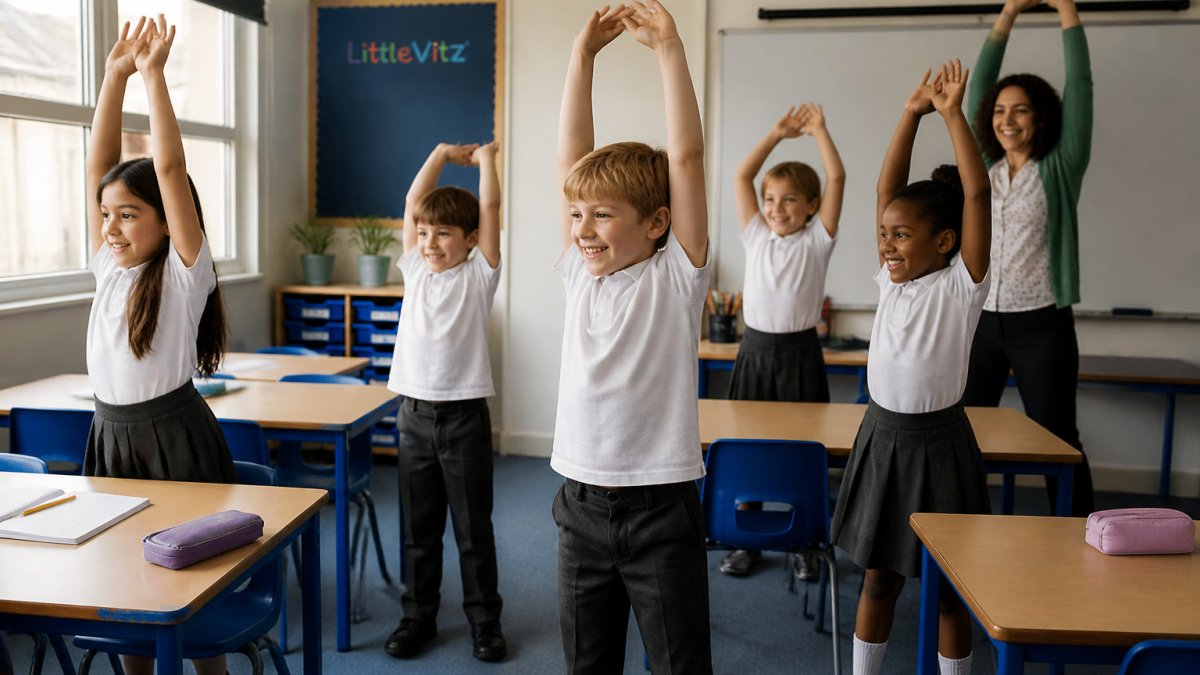
A group of primary school children stretching beside their desks during a short movement break, with a teacher smiling nearby, can show how simple these breaks look in practice. Movement helps students shake off restlessness and return ready to learn (Physical activity helps children to deal with life’s challenges).
Good brain breaks include:
- Stretch and reach. Ask students to stretch up high, then touch their toes.
- Animal walks. Have them crab-walk or bunny-hop across the room and back.
- Quiet breathing. Lead five slow breaths together, counting in and out.
Using the same break routine often can help, as children tend to feel calmer when they know what comes next.
Classroom Focus Activities You Can Run in Five Minutes
Sometimes you only have five minutes. These quick activities fit neatly into a gap between lessons or at the start of the day.
Mental maths sprint. Ask five simple sums, one at a time. Students show answers on fingers or mini whiteboards.
Spot the difference. Show two similar pictures on the board. Students compete to find the changes first.
Silent challenge. Give a short task, like sorting a set of cards, and see how long the class can work in silence.
Tip: Use a visible timer. Children focus better when they can see time passing.
Trying Your First Focus Game at Home or School This Week
Starting is the hardest part, so keep your first attempt small. Pick one game from this guide that matches your child's age and needs.
Here is a simple plan for your first week:
- Day 1: Try one no-equipment game, such as Simon Says.
- Day 2: Repeat it and add one extra step to the instructions.
- Day 3: Introduce a timer and see how the child responds.
Keep a quick note of how each session went.
Focus grows gradually. A few minutes of play each day will do more good than one long session once a week. Start small, keep it fun, and celebrate the progress you see.
Frequently Asked Questions
What are some simple focus games for elementary students?
Simple focus games include Simon Says, I Spy with a single sound instead of a colour, Freeze Dance, and Copycat clapping patterns. Each takes under five minutes, needs no materials, and asks children to listen carefully, follow a rule and stop or start on cue. Start with games that have one clear instruction, then add a second step once children manage the first comfortably.
How long should a focus activity last for children?
Most elementary students stay on task for short bursts, so keep focus games between two and five minutes for younger children and up to ten minutes for older pupils. Finish while they still want more. Short, frequent games tend to work better than one long session, and you can repeat the same game across the week to build confidence and skill.
Which games help children practise listening and self-control?
Games with a stop signal are especially useful. Try Red Light, Green Light, Musical Statues or a clap-and-repeat pattern where children must wait for the signal before moving. These build listening, impulse control and self-regulation together. Praise children for pausing well, not just for winning, so the focus on self-control stays positive.
Can movement games help students focus?
Yes. Short movement games such as Simon Says, Freeze Dance or a quick stretch-and-count routine can reset attention after a long period of sitting. Movement works best as a brief break placed between tasks, not as a replacement for focused work. Keep instructions clear so the physical activity links back to listening and following directions.
