

Table of Contents
- What Executive Function Looks Like in Everyday Family Life
- Daily Routines for Executive Function: Small Habits, Big Gains
- Executive Function Activities for Home: Play That Builds Brain Skills
- Nutritional Support for Child Focus: What Goes on the Plate
- Breaking Big Tasks Into Small Steps Without the Battles
- Supporting Self-Regulation and Emotional Regulation at Home
- Transition Support: Moving Between Home and School Environments
- Conclusion
- Frequently Asked Questions
Last Updated: September 16, 2026
What Executive Function Looks Like in Everyday Family Life
Executive function is the set of mental skills that help children plan, focus, remember instructions and manage their emotions. In family life, it's the reason your child can (or can't) get shoes on without five reminders, start homework without a meltdown, or wait their turn when a sibling grabs the last biscuit. This guide from LittleVitz is about supporting those skills naturally, at home, without turning your kitchen into a clinic.
Daily Routines for Executive Function: Small Habits, Big Gains
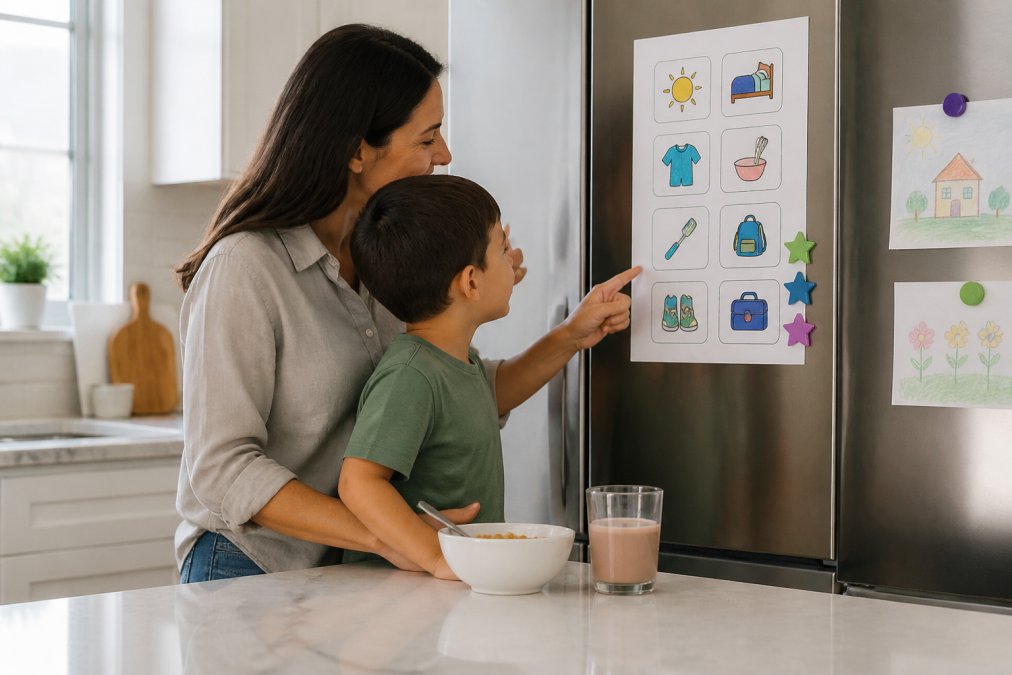
Daily routines are one of the most effective natural ways to support executive function in children because they reduce the mental effort each step requires. When the sequence is predictable, your child isn't re-deciding what happens next, so more focus is available for the task itself.
Visual Schedules and Checklists That Children Actually Use
A visual schedule works when your child can follow it without you narrating every step. That means pictures, not paragraphs, and no more than five or six steps per routine.
- Wake up and use the toilet
- Get dressed (clothes laid out the night before)
- Eat breakfast
- Brush teeth
- Shoes and bag by the door
Executive Function Activities for Home: Play That Builds Brain Skills
Executive function activities for home work best when they feel like play, not practice. The goal is to gently stretch working memory, impulse control and flexible thinking while your child is having fun, which is when learning sticks. What matters more than the game itself is the mechanism: each activity should ask your child to hold something in mind, resist an impulse, or shift a rule, ideally one of those at a time, not all three.
Games for Working Memory, Inhibition and Cognitive Flexibility
- Working memory: "I went to the shop and I bought..." (each player adds an item and repeats the list), or asking your child to fetch three things in one trip. The stretch comes from the number of items, so start with two and add one only when they succeed.
- Inhibitory control: Musical statues, "Simon says", or freeze-dance games where stopping is the challenge. The pause between the music stopping and your child stopping is the skill being trained, resist the urge to speed it up.
- Cognitive flexibility: Sorting games where the rule changes midway ("now sort by colour, now by size"), or storytelling where each person flips the plot. Announce the rule change clearly the first few times, then let your child predict it.
Board games and card games do a lot of this work too, and they add turn-taking, which is inhibitory control in disguise. Ten to fifteen minutes a day is plenty. A useful rule of thumb: if your child is winning easily every time, the activity is too easy; if they're melting down every time, it's too hard. Aim for the middle.
Making Activities Sensory-Friendly
Most activity advice assumes a child who is comfortable with noise, touch and movement. If your child is sensitive to any of those, the same games can be adapted rather than abandoned:
- For children who find noise overwhelming: swap musical statues for a silent version using a hand signal or a light tap on the shoulder as the "stop" cue.
- For children who seek movement: build the movement into the game rather than trying to suppress it, for example, a memory game where each correct answer earns a lap of the room.
- For children who dislike being touched: avoid games that rely on tagging or guiding by hand; use verbal or visual cues instead.
- For children who struggle with visual clutter: use one game at a time, put the box away, and keep the play surface clear.
Nutritional Support for Child Focus: What Goes on the Plate
In practice, that looks like:
- A protein element at breakfast (eggs, yoghurt, beans, nut butter)
- Fruit or veg with a fat or protein alongside, rather than alone
- Regular meals and snacks, so blood sugar doesn't crash mid-afternoon
For families where greens simply aren't happening, a supplement can help fill the gap. LittleVitz Kids Super Greens is a chocolate-flavoured powder made with real greens, fruits, vitamins and minerals, designed to mix into milk or a smoothie. It has no added sugar, which matters if you're trying to avoid the blood-sugar spikes that work against focus. There's a trial and travel pouch if you'd rather test it before committing to a full tub.
Breaking Big Tasks Into Small Steps Without the Battles
Task breakdown is the single most useful technique for reducing resistance, because most "won't do it" moments are actually "don't know where to start" moments. A child staring at "tidy your room" sees an impossible mountain. A child staring at "put the books on the shelf" sees something they can finish.
Try this sequence:
Kids Super Greens - 25 Servings →
- Name the finished result in one sentence ("the floor is clear").
- List the steps out loud, ideally with your child.
- Start with the smallest, easiest step to build momentum.
- Stay nearby for the first step, then step back.
Supporting Self-Regulation and Emotional Regulation at Home
Self-regulation and emotional regulation grow from co-regulation: children borrow an adult's calm before they can generate their own. This isn't a metaphor. When a child is dysregulated, the thinking part of their brain (the prefrontal cortex) is effectively offline, and the emotional alarm system is running the show. Your steady voice, slow breathing and unhurried body language are literally sending signals that it is safe to come back online.
The Parent's Own Regulation Matters Too
Here is the part most guides skip: your child's ability to borrow your calm depends on you having some to lend. If you are running on empty, broken sleep, back-to-back demands, your own unresolved stress, your nervous system will struggle to offer the steady presence your child needs. This is not a character flaw. It is biology, and it is one of the most common reasons parents feel they are "failing" at co-regulation.
- Regulate yourself first, even for ten seconds. Before you respond to a meltdown, take one slow breath out, longer than the in-breath. This is not about being calm; it is about giving your own nervous system a chance to shift before you speak.
- Lower your voice rather than raising it. A quieter, slower voice is more regulating than a louder one, even when it feels counter-intuitive.
- Name your own state out loud, age-appropriately. "I'm feeling frustrated too, so I'm going to take a breath." This models the exact skill you are trying to teach.
- Protect one recovery point in your day. A cup of tea without demands, a walk, a phone call, something that is yours. Parental burnout is real and it directly affects your child's regulation, because co-regulation is a two-person job.
Transition Support: Moving Between Home and School Environments
Transition support is where home and school either reinforce each other or work against each other. Children with weaker executive function often cope at school by holding it together all day, then fall apart the moment they're home. That after-school meltdown is usually exhaustion, not defiance.
What helps:
- A predictable wind-down routine after school, with a snack and quiet time before any demands
- Warning before transitions ("ten minutes until we leave"), rather than sudden announcements
- A simple shared system with school, such as the same visual symbols or a home-school book
Conclusion
Supporting executive function naturally isn't about adding more to your plate. It's about reducing the mental load on your child's, with predictable routines, play that builds skills, food that fuels focus, and calm co-regulation when things go sideways.
Frequently Asked Questions
What are the signs of poor executive function in children?
Common signs include difficulty starting tasks, losing track of instructions, trouble waiting their turn, and forgetting what they were asked to do moments earlier. A child may seem to 'not listen' when the real issue is working memory or task initiation. These patterns are more noticeable during transitions, homework or getting ready in the morning. If concerns persist across home and school, speak to your GP or a paediatric professional for advice.
How does nutrition impact executive function in kids?
The brain uses a large share of a child's daily energy and nutrients, so gaps in iron, zinc, omega-3 fats and B vitamins can affect focus, mood and mental effort. Regular meals with protein, colourful vegetables and fruit support steadier attention than sugary snacks. For picky eaters, a chocolate-flavoured greens powder such as LittleVitz Kids Super Greens can help bridge nutritional gaps without added sugar, mixed into milk or a smoothie as part of the daily routine.
Can physical activity improve executive function?
Yes. Movement that gets the heart pumping, such as running, cycling, swimming or dancing, is linked to better focus and attention in children. Activities that combine movement with thinking, like obstacle courses, clapping games or ball games with rules, also practise inhibitory control and cognitive flexibility. Short bursts count: ten minutes of active play before homework or after school can make the next task feel easier for many children.
Are there natural supplements that support brain health in children?
Some families use children's vitamin powders or greens blends to fill nutritional gaps when diets are limited. LittleVitz Kids Super Greens is a chocolate-flavoured powder made with vegetables, fruits, vitamins and minerals, designed to mix into milk, smoothies or shakes. It is not a medicine and does not treat any condition, but it can be a convenient addition to a child's routine. Always check with your GP or pharmacist before starting any supplement, especially if your child takes medication or has allergies.