

Table of Contents
- How Outdoor Play Supports Child Attention and Focus
- Physical Activity and Concentration: The Connection
- Outdoor Activities to Improve Concentration in Children
- How Much Outdoor Play Do Children Need
- Stress Reduction and Emotional Regulation Outdoors
- Ways to Encourage Outdoor Play in Your Daily Routine
- Supporting Your Child's Attention with Nutrition and Outdoor Time
- Frequently Asked Questions
Last Updated: October 13, 2026
How Outdoor Play Supports Child Attention and Focus
Getting children outside isn't just about fresh air and exercise, outdoor play child attention is one of the most effective ways to build stronger focus and concentration.
The connection runs deeper than most parents realise. Outdoor environments offer what indoor spaces can't: unlimited sensory input, constant problem-solving, and freedom from the structured demands that overwhelm developing brains.
At LittleVitz, we know supporting focus means combining movement, exploration and proper nutrition.
Physical Activity and Concentration: The Connection
Movement and concentration are deeply linked. When children run, climb, swing, and explore, they activate their bodies in ways that support focus.
Physical activity increases blood flow to the brain and releases chemicals that improve mood and mental clarity.
The benefits aren't instant, but they're consistent.
For children who struggle to sit still or focus indoors, outdoor physical activity is especially valuable, not forced exercise, but a natural way to help their developing brains work better.
Outdoor Activities to Improve Concentration in Children
Not all outdoor time is the same. Some activities support attention development better than others, and the best choices depend on your child's age, temperament and any sensory or mobility needs. Here are realistic, age-banded ideas, plus how to adapt them for every child.
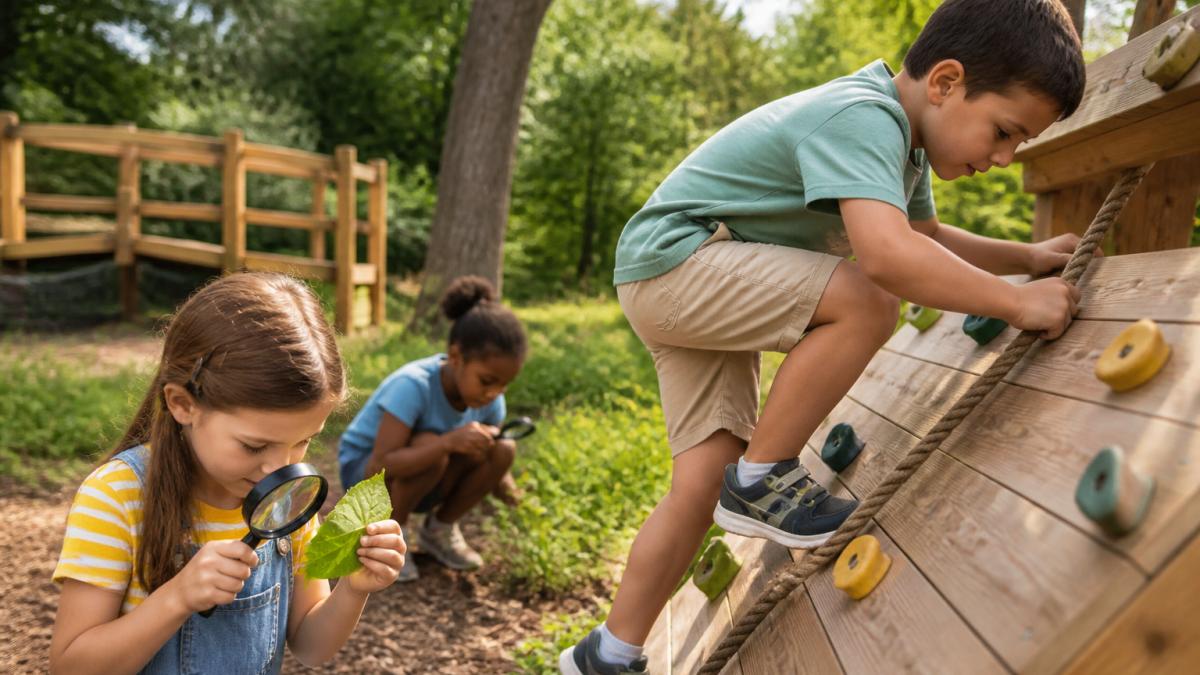
Unstructured Free Play and Exploration
Free play is where attention skills truly develop. When children play without adult direction, they're constantly making decisions, solving problems, and adjusting their focus to what captures their interest.
Unstructured outdoor play, climbing, digging, building with sticks, requires sustained attention.
This type of play also teaches children to manage their own attention span, sticking with something challenging and shifting focus when they need a break.
The beauty of free play is that it requires almost nothing, just outdoor space and permission to explore.
Nature-Based Learning and Observational Skills
When children observe nature, they're training their attention in powerful ways. Looking closely at insects, plants, or weather patterns requires sustained focus and develops observational skills that support concentration.
Nature-based learning doesn't need to be formal. Encouraging your child to notice things, the colour of leaves, the movement of birds, the texture of bark, trains their brain to attend to detail, strengthening their ability to concentrate on other tasks.
Many children find nature inherently interesting, so they maintain attention longer without prompting, exactly the voluntary sustained attention you want to build.
Age-Specific Outdoor Play Plans
Attention looks different at every stage, so the activities that build it should shift too. These are starting points, not scripts, follow your child's lead.
Toddlers (roughly 1-3 years)
- What builds attention: short, sensory-rich, repetitive play with a clear physical element.
- Try: filling and emptying a bucket with leaves or stones; pushing a ball across grass; splashing in a shallow puddle; following a simple 'find three red things' prompt.
- Realistic session: 15-25 minutes, ideally twice a day. Attention spans at this age are measured in minutes, so expect to move between activities.
Preschoolers (roughly 3-5 years)
- What builds attention: pretend play, simple collecting, and tasks with a beginning and an end.
- Try: building a 'fairy house' from sticks and moss; hunting for minibeasts under logs; making mud pies; watering plants with a small can.
- Realistic session: 30-45 minutes of free play, with one adult-led activity if your child asks for direction.
Early primary (roughly 5-8 years)
- What builds attention: rule-based games, problem-solving, and physical challenge.
- Try: obstacle courses made from garden items; den-building; bug or plant identification with a simple chart; skipping, hopping and balancing games.
- Realistic session: 45-60 minutes, ideally daily, mixing movement with quieter observation.
Older primary (roughly 8-11 years)
- What builds attention: projects that stretch over days, teamwork, and skill-building.
- Try: growing something from seed and tracking it; building a bird feeder; orienteering or geocaching; team sports or cycling.
- Realistic session: 60 minutes or more, with some sessions devoted to a longer-term project.
Inclusive and Accessible Outdoor Play
Every child deserves access to outdoor play, regardless of ability or sensory needs. Making outdoor time inclusive means thinking about the barriers your child might face and problem-solving around them.
- Mobility differences. Outdoor spaces don't need to be perfectly flat. Adapted equipment, firm surfaces for wheels, and permission to move in their own way all help. A child using a wheelchair can explore a garden, feel different textures, and experience nature fully.
- Sensory sensitivities. Quieter spaces away from busy parks, or visiting at off-peak times, can make outdoor time manageable. Some children need a gradual introduction to outdoor sensory input, start short and calm, then build up.
- Children who feel uncomfortable outdoors. Anxiety about insects, weather or unfamiliar spaces is common. Sitting on a doorstep with a drink, watching birds, or bringing a favourite toy outside can be a gentle first step. The goal is comfort, not distance covered.
Safety, Weather and Access
Practical barriers stop more outdoor play than lack of interest does. A few things worth planning for:
- Weather. Dressing for the conditions, waterproofs, wellies, layers, sun hats, keeps play going through most of the year. Rain, wind and cooler temperatures don't make outdoor play unsafe; they make it different, and offer unique sensory experiences.
- Heat and sun. On warmer days, aim for morning or late afternoon, keep water available, and use shade. Very young children overheat more quickly than adults.
- Air quality. On days when local air quality is poor, shorter sessions or indoor alternatives are sensible. Check your local authority's air quality alerts if your child has asthma or other respiratory conditions.
On days when outdoor play isn't possible, indoor play spaces, conservatories or covered outdoor areas can provide some of the same benefits, movement, exploration, and freedom from structured demands.
How Much Outdoor Play Do Children Need
The honest answer is that there's no single, evidence-backed number that guarantees attention benefits. Most practitioners find regular, repeated outdoor time matters more than hitting a daily target, and that free, self-directed, varied play does more for focus than the clock does.
That said, some widely used reference points are worth knowing:
- The Chief Medical Officers' physical activity guidelines for the UK recommend that children and young people aim for an average of at least 60 minutes of moderate-to-vigorous physical activity per day across the week, and that children under five aim for at least 180 minutes spread across the day once they are walking (UK Chief Medical Officers' physical activity guidelines). Outdoor play is one of the easiest ways to accumulate that movement, but the guidelines are about physical activity, not attention specifically.
- Outdoor time and physical activity are not the same thing. A child can spend an hour outdoors sitting and observing, which may support calm and observational focus, but won't deliver the same movement-driven benefits as climbing, running or digging.
- Frequency appears to matter more than duration. A common pattern parents describe is that 20-30 minutes of free outdoor play most days produces steadier focus than a single long weekend session. This is a pattern, not a proven rule, the research base on timing and dose for attention is still thin.
What the research does and does not show
Much of the evidence linking outdoor time and nature exposure to attention comes from observational studies, which can show a relationship but cannot prove that outdoor play causes better attention.
A smaller number of experimental studies (including work on green schoolyards and nature walks) suggest short-term improvements in sustained attention after time in natural settings, but sample sizes are often modest and measures vary.
A practical way to think about timing
Rather than chasing a target, watch your own child's patterns:
- Before focused tasks. Many families find 20-30 minutes outdoors before homework, mealtimes or quiet activities helps their child settle.
- After long stretches indoors. A midday reset outdoors often reduces afternoon restlessness.
- Consistency over intensity. Five short sessions across a week tend to do more than one long outing.
If your child has attention difficulties, more frequent, shorter outdoor breaks are easier to build into the day than one long block.
Measuring whether it is working
You don't need a formal assessment to notice change. Observable indicators you can track at home include:
- Time on task, how long your child stays with a puzzle, book or building project before moving on.
- Ease of returning to an activity, how quickly they re-engage after a break or interruption.
- Transition smoothness, fewer protests when shifting from play to a quieter task.
Keep a simple note for a fortnight. If you see steadier patterns, keep going. If nothing changes, it may be worth speaking to your GP, health visitor or school SENCO. Outdoor play is a supportive habit, not a treatment.
Stress Reduction and Emotional Regulation Outdoors
Outdoor environments naturally calm the nervous system.
Stress and anxiety make it harder for children to focus. A child who feels overwhelmed will struggle to maintain attention, no matter how interesting the task.
Nature exposure also reduces sensory overwhelm. For children who find indoor environments, artificial lighting, background noise, structured demands, too stimulating, outdoor spaces offer a reset.
Many parents notice children are happier and more cooperative after outdoor time.
Ways to Encourage Outdoor Play in Your Daily Routine
Making outdoor play a consistent part of family life doesn't require perfect weather or elaborate plans, just building it into your rhythm and removing barriers.
Start small. If outdoor time isn't yet routine, begin with 15-20 minutes most days and build from there.
Keep it low-pressure. You don't need to organise activities or supervise closely.
Have outdoor clothes and shoes ready.
Making Outdoor Time Work for Different Weather
British weather isn't always cooperating, but that doesn't mean outdoor time stops. Playing in different conditions offers unique sensory experiences and teaches resilience.
Rain, wind and cooler temperatures don't make outdoor play unsafe, they make it different.
The key is appropriate clothing. Waterproof jackets, wellies and layers mean your child can play comfortably in almost any weather, and many parents find children who play in varied weather develop stronger focus and resilience.
Inclusive Outdoor Play for All Children
Every child deserves access to outdoor play, regardless of ability or sensory needs.
For children with mobility differences, outdoor spaces don't need to be perfectly flat or highly structured.
For children with sensory sensitivities, outdoor time might mean quieter spaces away from busy parks, or visiting at times when there's less noise and activity.
For children with ADHD or attention difficulties, outdoor play is often especially beneficial, and sometimes especially challenging to initiate.
Supporting Your Child's Attention with Nutrition and Outdoor Time
Outdoor play is powerful, but it works best alongside proper nutrition, a child's ability to concentrate depends on their brain having the fuel it needs.
Regular movement and outdoor exploration increase your child's nutritional needs, particularly for energy, focus and immune support.
At LittleVitz, we've designed our nutrition powder to support exactly what active, developing children need.
The combination is simple: outdoor play + proper nutrition = better attention, stronger immunity and healthier development.
Outdoor play is one of the most effective, free tools you have for supporting your child's attention and focus.
| Activity Type | Best For | Time Needed |
|---|---|---|
| Unstructured free play | Building attention span and decision-making | 20-60 minutes |
| Nature exploration | Developing observational focus | 15-30 minutes |
| Physical climbing/movement | Regulating nervous system | 20-45 minutes |
| Imaginative outdoor play | Creative problem-solving | 30-60 minutes |
Frequently Asked Questions
How can outdoor play support a child's attention span?
Outdoor play strengthens attention through physical activity, sensory stimulation, and reduced screen time. Natural environments lower stress hormones, allowing children to focus better. Unstructured outdoor time also builds executive function and self-regulation skills, abilities that help children sustain attention in school and at home. Regular outdoor exposure has been linked to improved concentration and fewer attention-related difficulties.
What outdoor activities can help children practise focusing?
Nature exploration, bug hunting, building with sticks or stones, and playground games all require sustained attention. Gardening, nature sketching, and scavenger hunts encourage observational skills and problem-solving. Even simple activities like swinging or climbing demand focus and body awareness. Free play outdoors, where children direct their own activity, naturally builds concentration because they're engaged in something they find interesting.
How much outdoor play should children have each day?
Most child development guidance recommends at least 60 minutes of outdoor time daily for young children, though more is beneficial. This doesn't need to be continuous, short outdoor breaks throughout the day add up. Even 15-20 minutes of outdoor play can improve focus and mood. The key is consistency and regular nature exposure, rather than one long session per week.
Does spending time in nature really help children concentrate?
Yes. Research shows that nature exposure reduces mental fatigue and restores attention capacity. Green spaces lower stress levels, which removes a major barrier to concentration. Children who spend regular time outdoors show improved ability to focus on tasks, better school readiness, and stronger problem-solving skills. The combination of physical movement, fresh air, and sensory stimulation creates ideal conditions for attention development.